

Building Hope
We choose hope by coming together and working together – just as many of us did last Saturday.

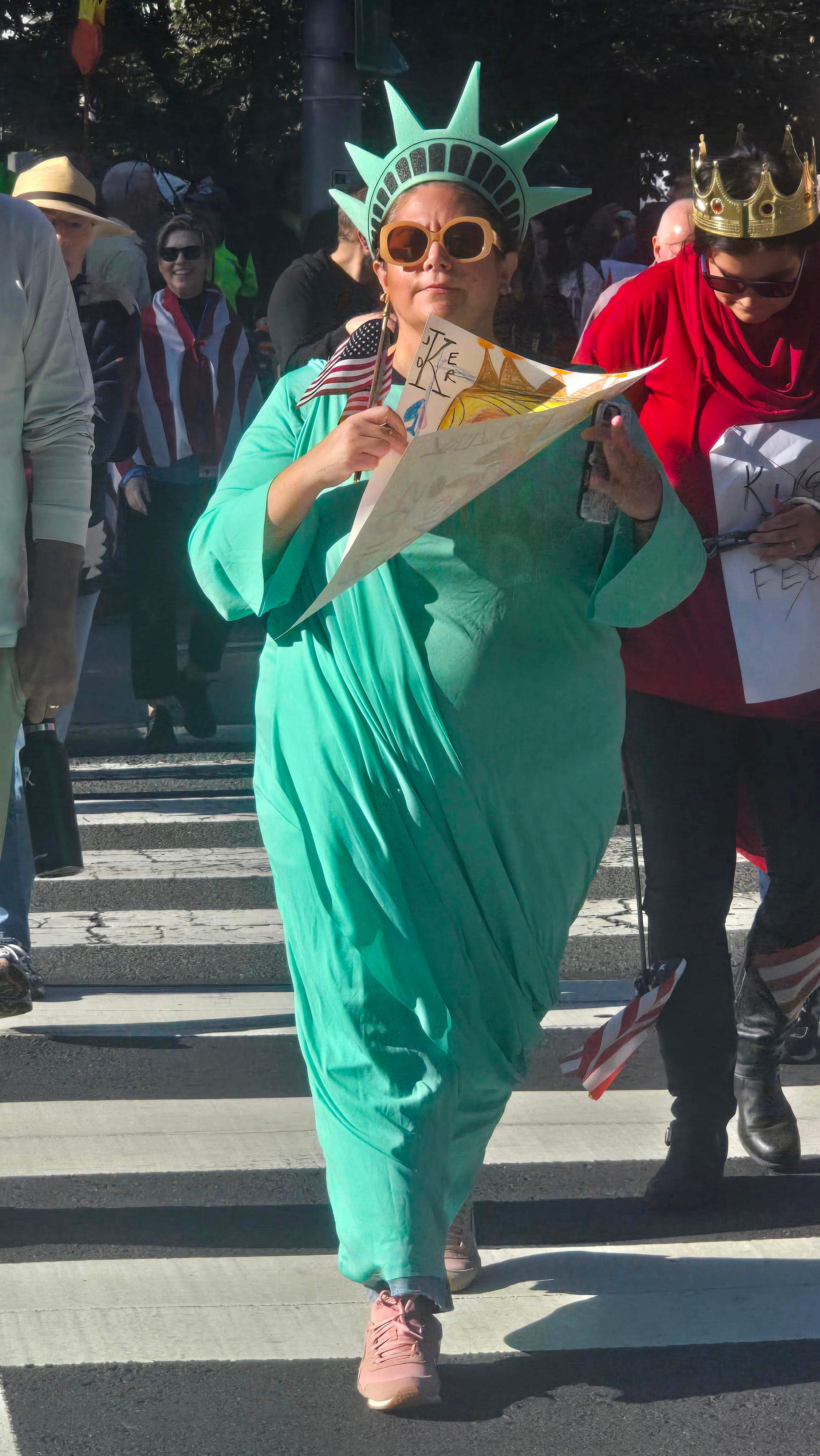
I went to the No Kings rally in Princeton, N.J., last weekend, and came away feeling much better than I expected to. A speaker estimated the size of the crowd at 5,000 (a drone was flying overhead); my guess is probably 3,000, roughly 10 percent of Princeton’s population. Turnout was all the more impressive given that Princeton University students were on fall break. A nearby curb was also lined with people, including Lady Liberty below, carrying signs urging drivers to honk in solidarity. The constant honking sounded like a two hour wedding procession.
At first, I felt a little silly, as I often do at protests – dutifully chanting when called on and applauding a series of speakers determined to rouse us by bellowing into the mike. They recited a litany of very real wrongs – against the environment, immigrants, federal workers, the rule of law and the basic tenets of our democracy. Yet it felt as if they were preaching to the converted. I worried that we were all ritualistically shaking our fists at an out-of-control government breaking laws and norms with abandon, but one that we were powerless to change.
Gradually, however, I realized that it was our simple presence that mattered. We were willing to give up part of our Saturdays to come together for the sake of our country. We were there precisely because we wanted to be counted, counted as citizens willing to stand up and tell the Trump Administration: We are watching. We will take to the streets if necessary. And our numbers are growing.
From the first No Kings rally in June through this one, the estimated number of protesters has grown from five million to seven million. Twelve million would constitute 3.5 percent of U.S. society, the magical mobilization threshold that political scientists Erica Chenoweth and Maria Stephan have found to be necessary for successful nonviolent anti-authoritarian grassroots movements.
Beyond the numbers, what lifted my spirits was seeing what my fellow protesters were fighting for. It was a “No Kings” rally, after all, so we proclaimed our opposition to a return to monarchy in any form. We were standing on hallowed Revolutionary ground, right next to the colonial home built by Richard Stockton, who signed the Declaration of Independence. We were down the road from the main battlefield of the Battle of Princeton, and barely an eighth of a mile from Nassau Hall, which still bears bullet holes from the battle. The Battle of Princeton followed the Battle of Trenton, which George Washington successfully fought after crossing the Delaware; these were the turning points of the war. I could imagine the chant “No Kings” echoing across the centuries.
Many signs around me, in red, white, and blue lettering and accompanied by many U.S. flags, embraced the country those soldiers brought into being. “For the ❤️ of this Country.” “We the People Love & Support this Constitution for the United States of America.” “We Love America.” “Together We Rise, Save Democracy.” Others bore messages applicable anywhere. “Choose Love, Choose Peace.” “Hate Never Made Anything Better,” “Love your neighbor.” “Liberty and Justice for All.” The patriotism was palpable and welcome.
As the afternoon wore on, the speakers began calling for us not just to oppose, but to build, to “practice the future we long for,” to “live in extraordinary love, extraordinary connection, and extraordinary courage.” A young man from the Bayard Rustin Center for Social Justice in Princeton went further, asking us to imagine a future of radical inclusion, in which everyone would feel accepted regardless of how they might differ from an imagined norm. He urged us to “build networks of care that cruelty and intimidation can’t touch.”
Faithful readers of The Renovator will recognize the resonance of that language with my discussion of care in my last column. Care requires connection; that connection in turn expands outward to community. All of us can do more, right now, to establish connections with those we don’t know, don’t like, or even fear. I have started reading books and articles published by thinkers whom I know to be more conservative, looking for places we agree and could perhaps make common cause. The importance of care, family, and community is one such place, even if we disagree that chosen families are just as much “family” as biological families. Another simple shift in attitude that could lead to many more conversations is to ask ourselves when we meet a voter “from the other side,” to wonder and ask them why they voted the way they did, rather than assume we know the answer.
The final speaker was New Jersey State Senator Andrew Zwicker. He told us that our job was “to build hope,” which he described as “not an emotion, but a choice.” We build it by coming together and working together, just as we were all doing on Saturday.
As I came away, I reflected on the power of “we the people.” So often over the past decade I have thought first of the majority of the people living in the 13 colonies at that time who were not included in that “we,” at least not as citizens with civil rights of any kind. But today I thought of how that “we” had steadily expanded, and how we can build a better “we” right now — a “we” that believes in hope over hate, truth over tribes, and connection over division. That “we” also demands a government that works to improve our life, liberty, and pursuit of happiness.
That “we” is already the “exhausted majority” of the American people; we must now find one another, tell the country and the world we exist, and make ourselves heard.
 | A guest post by
|