

Avoiding Politics and Religion is Just Fine!
Learning to see one another differently through the holidays.

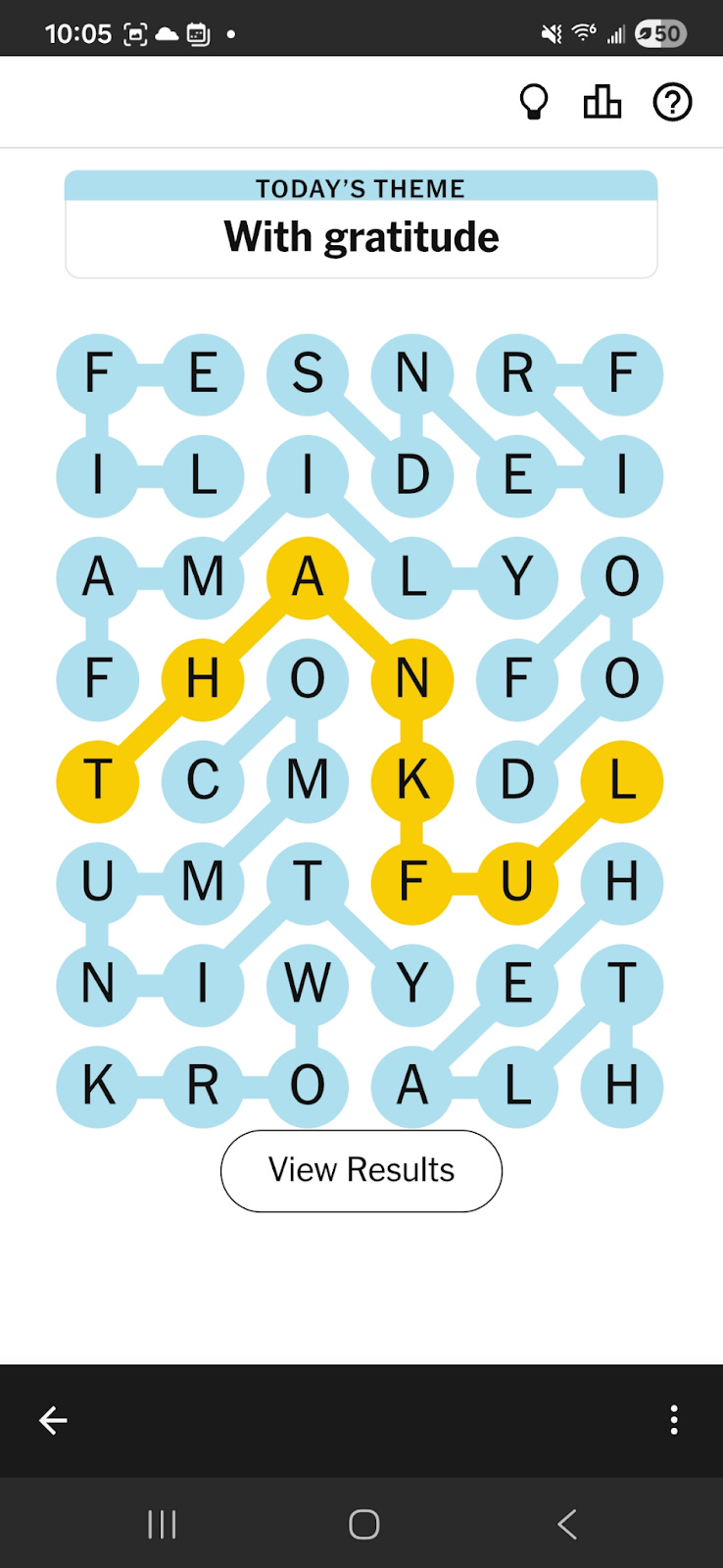
I have a routine designed to start my day with a dose of perspective and pleasure. I wake up, go downstairs to get that first wonderful cup of coffee, then bring it back to bed and sip it while I read some classic that I should have read in college but never did -- a Shakespeare play, Marcus Aurelius’ meditations, something that has endured through time and is far from the day’s news. It helps keep me sane. And then I do a couple of New York Times games (start the day with play!), generally Strands and the mini-crossword. I have to save Spelling Bee for later, or I will never get up.
On Thanksgiving morning, the theme of Strands was “With gratitude,” and the “spangram” -- a word that goes across the entire square -- was “thankful.” Hardly a surprise! As you can see, the words to be found were life, health, work, family, friends, and community.
That is precisely the breakdown of human needs that my colleague Elizabeth Garlow and I have written about, revising Abraham Maslow’s well-known hierarchy of needs. On one side of the ledger, life, health, and work are necessary for us to develop ourselves as individuals and achieve Maslow’s peak goal of self-actualization. For Maslow, the stuff on the other side – family, friends, and community – fall in the middle of the hierarchy, in the category of love and belonging. We argue that both sets of needs, those of separation and those of connection, are equal.
America’s founders appear to have been more interested in the individualist side of these needs, asserting the universal rights of life, liberty, and the pursuit of happiness. You will search in vain through our founding documents for positive mentions of family, friends, or belonging. The Federalist papers do talk a good bit about community, but chiefly in the context of the body politic.
Today, however, we know that happiness is much more likely to be found through human connection than the acquisition of material goods or the fulfillment of personal ambition. Social connection is consistently the most reliable predictor of happiness; conversely, isolation or loneliness undermines wellbeing and actual physical health.
As I wrote in my column Family First, I believe deeply that we need to build a society that values and serves our need for connection as much as for separation, for belonging as much as self-actualization. Adopting that dual perspective on who we are and what we need will require major changes in how we think about the very purpose of government: Not just to keep us safe, but to keep us connected. Step one is to reject a politics of division and hate.
Which brings me back to Thanksgiving and holiday table etiquette. If you read the op-ed pages and Substacks last week, you might have thought the Thanksgiving table is less a celebration of family, friends, and community than a political battleground requiring advance preparation with advice and weaponry. My favorite example this year came from Oren Cass, chief economist at American Compass, who wrote a hilarious piece on “how to shut down your boomercon uncle,” providing arguments and evidence to counter a hypothetical conservative boomer Uncle Gary who is opposed to Trump’s tariffs. On the left, Maureen Dowd turns her column over to a letter from her Trump-supporting brother Kevin, giving her readers a foretaste of views they are likely to encounter.
As a Virginian, I grew up with the dictum: “never discuss politics or religion at dinner parties.” Google tells me that Mark Twain is the original author of what has become a “rule of etiquette”; he advised avoiding those subjects “in polite company.” Many people today seem to think that sticking to things we can be grateful for is cowardly, fleeing from the moral battleground that politics has become.
I beg to differ. If we really are to build a new and better America, we need to learn to see one another’s basic humanity and find similarity. That means learning how to foreground identities other than membership in a political tribe. We should try to see one another as fellow sports fans, music lovers, nature enthusiasts, history buffs, volunteers, community weavers, readers, walkers, parents, or pet owners. The Thanksgiving table, and indeed any dinner table, is an opportunity to discover earn where interests and passions intersect.
We have a compressed holiday season this year, with enough socializing to make even the extroverts among us hang back. But here’s a tip. Whomever you meet, in whatever circumstance, start by asking yourself: How can I find a way to connect? The answer is not that universal American question: “What do you do?”
Instead, ask questions that might uncover a common interest, a shared like or dislike. Examples: “What are your favorite things to do? What kinds of books do you most like reading? Where do you like to travel?” You will bring out different sides of yourself in exploring the different facets of others. You will also create a moment of connection that will brighten your day -- and could help save your country.