

How to End Our Zero-sum Politics
Hey, business leaders: Want a productive democracy? Try ranked-choice voting, like Alaska and Maine.

Meredith Sumpter is president and CEO of FairVote, a nonpartisan organization seeking better elections for every American.
The nation badly needs to get its act together. Americans are on edge. We’re anxious about the economy and the pace of change, cultural and technological. We’re worried about jobs, groceries, and runaway electric bills. It’s visible in every poll. When CBS asked for one word to describe the economy, 61 percent chose “uncertain.” Nearly six-in-10 believe the country is on the wrong track.
Yet instead of our political leaders coming together to address the concerns of voters, the gulf between the major parties has grown wider than ever. Governance is unstable; thoughtful and consistent policymaking is nearly unheard of. And Americans feel worse off as a result.
This type of polarization has never produced stable markets or lasting prosperity – and business leaders are noticing. What drives growth is rule of law and predictable regulation, which give companies the confidence to invest and innovate without constant disruption. Leaders in government, like leaders in business, are most successful in creating value when they: 1) listen to all their voters; and 2) focus on solving problems for the long term.
And just as companies are accountable to shareholders, elected leaders should be accountable to voters: They should work with others to deliver value to voters, or they should lose their jobs.
There are lots of positive reforms Americans can get behind to renovate our democracy, but ranked choice voting (RCV) would be the most meaningful for those looking to put aside polarization and gridlock for the cross-partisan work that is the foundation of a stable nation and prosperous economy.
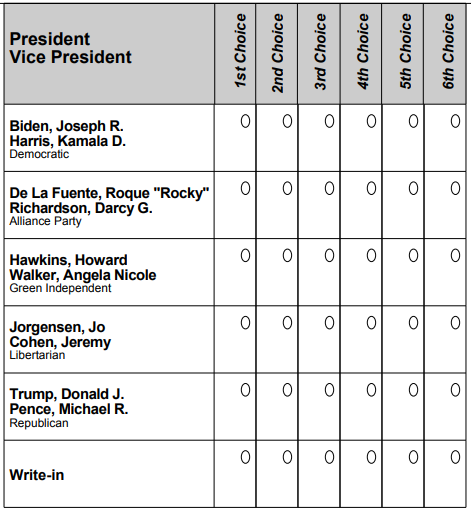
In any race with more than two candidates, RCV offers voters more choice and moves our elections away from hyperpartisanship and division. In our current system, candidates can coast to victory with far less than 50 percent of the vote – especially in partisan primaries. That creates a strategic incentive to attack opponents, fan flames, and lock up a small, unrepresentative base. In RCV elections, candidates need to win majority support. Successful candidates often earn the second- and third-choice support of voters who rank their opponents first. Instead of our current zero-sum game, RCV incentivizes candidates to focus on areas of agreement.
Look at how it’s worked in Alaska. Frustrated that politicians weren’t working together, and valuing a tradition of independent candidates, voters embraced a system that sent the four most popular candidates in an open primary on to a general election with RCV. The results reflect the political diversity of the state: Alaskans have elected a conservative governor and a moderate U.S. senator, and sent both a Republican and a Democrat to the U.S. House. State government, meanwhile, has been transformed: A bipartisan coalition of problem-solvers in the legislature now tends to work together to create actual results on the budget, energy, and education issues.
Across the continent, Maine has also used ranked choice voting to elect its members of Congress, selecting a mix of Democrats and Republicans. Both Alaska and Maine’s delegations feature a diverse set of bridge-builders, such as moderate Republicans Sens. Lisa Murkowski and Susan Collins, independent Sen. Angus King, and Blue Dog Democratic Rep. Jared Golden. All are among the members of Congress most likely to work across the aisle, as ranked by the Lugar Center for Bipartisanship.

During the September 2023 shutdown dance that eventually led to Kevin McCarthy’s removal from the House speakership, Golden and Nebraska Republican Don Bacon put forth the bipartisan way forward. Last month, Murkowski broke with other Republicans to vote against President Trump’s newest nominee to the Federal Reserve over concerns that his appointment would “compromise… the perception of [the Fed’s] independence.”
Imagine that: Given a system that encourages elected officials to work on behalf of their constituents, a once-broken system can be repaired. Fix the perverse incentives that prevent lawmakers from working together – and that reward them for keeping the other side from getting any wins – and even our thorniest problems can be resolved.
In San Francisco, Daniel Lurie ran a unifying race in a ranked choice election last fall, and he has brought that same style to the mayoralty. Already, the city is making progress. Crime is down, sales tax revenues are up, tourists are returning – and the mayor’s approval rating is over 70 percent.
It’s a similar story in Portland, Oregon, where voters last fall elected their mayor and the city council for the first time with forms of RCV, which resulted in representation for business alongside labor, homeowners together with renters. Portland has many challenges, but voters prefer the new voting system by a 2-to-1 margin. The percentage who say that government is ineffective has declined from 59 to 39 percent. Those numbers still have room to improve, of course, but they’re now at a level Congress could only dream of.
Business leaders should pay attention. Given fair rules, positive incentives, and majority winners, Americans can elect politicians responsible to everyone. Our democracy can again be productive with innovative policies and laws that respond to voter needs rather than being captured by ideological rigidity. We can have more trusting and confident voters – fostering more secure, comfortable markets, and ensuring the success of what Malcolm Salter calls “democratic capitalism.”
After all, healthy markets depend upon both a functioning government and an empowered society. These are the underpinnings of stability and growth. It’s time for our politics to deliver positive outcomes for America’s shareholders -- our voters.
There is demand for reform. Yes, the peril is real, but so is the opportunity to turn things around. With ranked choice voting, we can move towards a more stable and less polarized governance system that favors voters and is good for business.
 | A guest post by
|