

The Lexington Experiment
Richard Young of CivicLex on what citizens' assemblies can achieve — and what they can't.

Editor’s note: Gideon ran this two-part column in April, but Lexington’s assembly got some big news this week, so it’s a great time to catch up with CivicLex!
Lexington, Kentucky, completed its first civic assembly in March. I’d been wanting to visit for a while to check out CivicLex, a possibly one-of-its-kind local democracy organization — on which more later. (Also, you may ask… Lexington? More on that later, too.)
Civic or citizens’ assemblies are hot right now — they’re the first thing anyone (including me) talks about when trying to explain to normal people what “democratic innovation” means. Some hail them as a cure to the ills of representative democracy: They’re consensus-driven, non-partisan, transparent, and reflective of the demographics of their community — everything legislatures aren’t.
So why, after hundreds or possibly thousands of such exercises around the world, do they rarely become entrenched? And why have only a handful happened in the US? I was hoping to find some answers in Lexington, and I kinda did.
After it was all over — and he’d gotten some sleep — I sat down with Richard Young, the head of CivicLex and a bit of a poster-boy for the democratic innovation crowd. He was actually a big skeptic of assemblies going in, and is more of a fan now — but he had some choice words for those who think they’re a cure-all.
We also talked about CivicLex, why it’s so hard for local democratic innovations to spread more widely — and what funders should be doing about it. That’s in part 2 of this series.
First, a bit of background on the assembly itself. It was convened to discuss two topics: Council members’ pay, and reform of the city charter. Three dozen residents from all walks of life, selected by sortition (i.e., at random), spent several days over the course of one month studying the issues. They talked to council members and legal experts and held a public town-hall meeting.
On the final weekend, which was when I showed up, they did two marathon deliberation sessions, with proposals and counter-proposals flying back and forth and giant Post-Its filling the walls. They ended up hashing out three recommendations to the city council, which will decide whether to put them on a city-wide ballot in November.
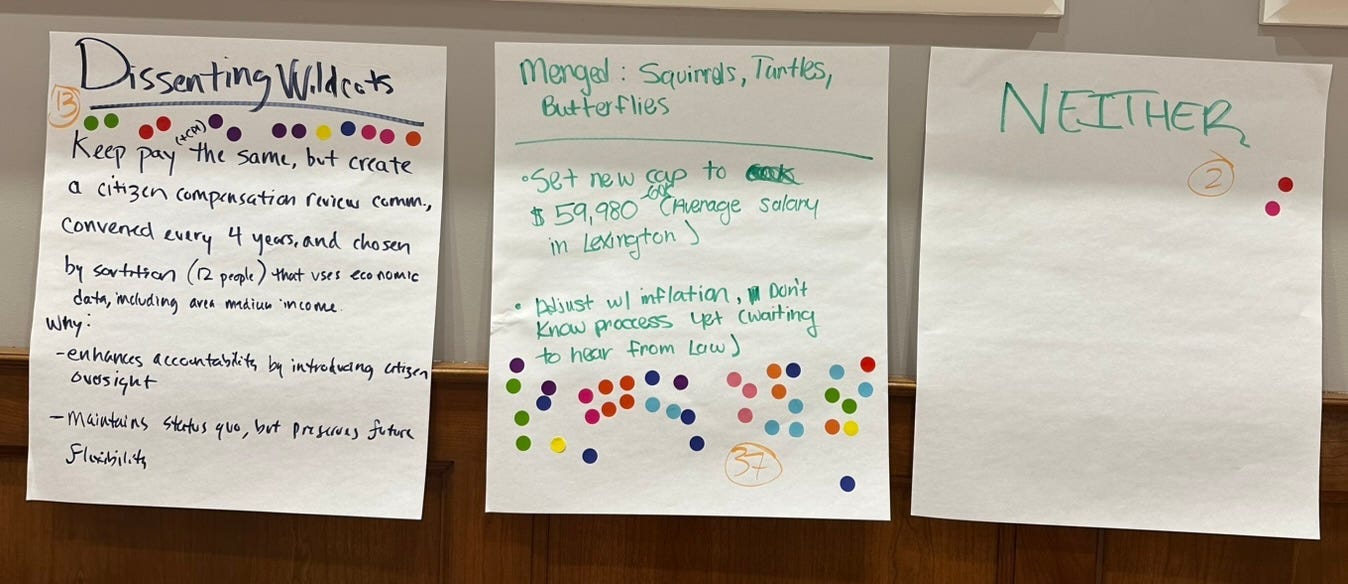
The first was on pay. Right now, councillors earn about $42,000 a year. For some, it’s a full-time job. As one assembly member said to me, that means “you have to be rich, retired, or a realtor” to run. Several seats regularly go uncontested. The assembly proposed increasing the salary to $59,987 a year — the exact average local wage — though several of them worried that to ordinary voters it would just look like the council giving itself a massive pay bump.
The second recommendation was for some rules to hold council members more accountable. Right now, astonishingly, they aren’t actually required to attend meetings, and there’s no public record of when they do. Lexington’s vice mayor, Dan Wu, told me there was one member who never showed up in their entire two-year term.
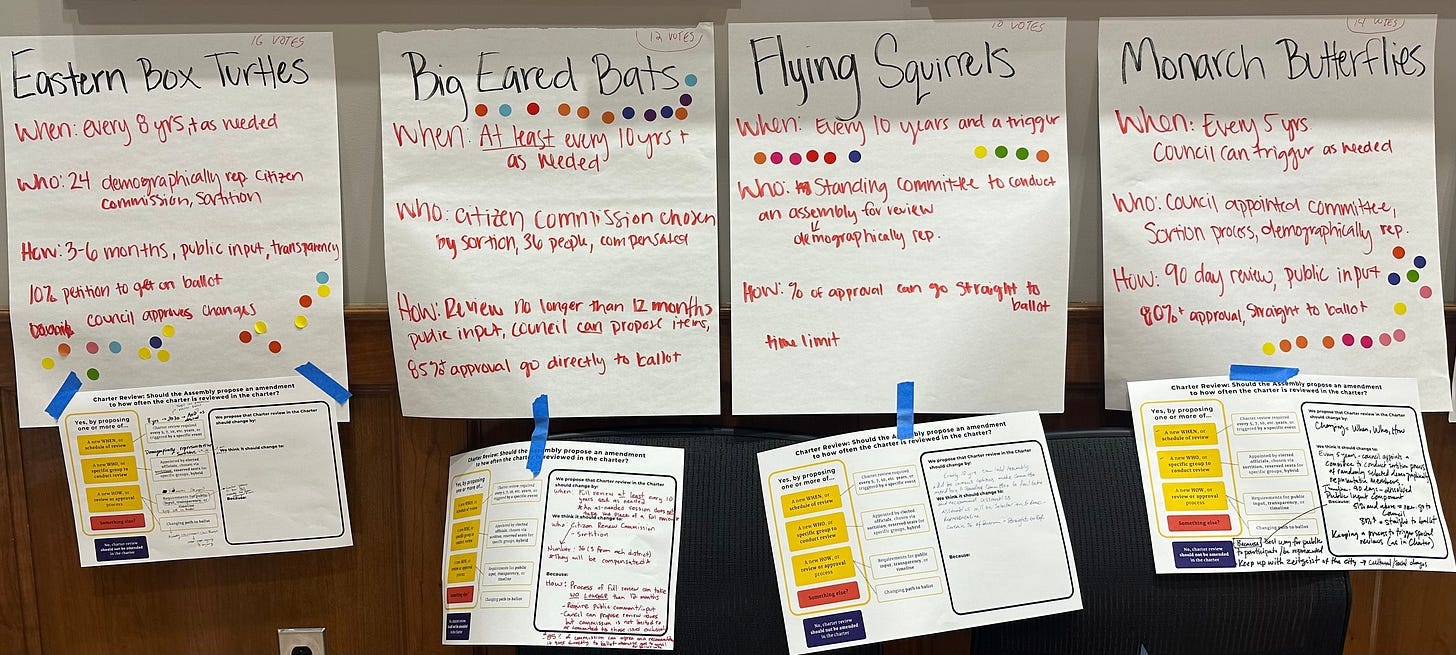
Both these things would require amending the city charter, which hasn’t been changed since 1998. So the third proposal was to require that the charter be updated every eight years. Proposed changes would be funneled through an independent commission chosen by sortition, much like the civic assembly itself.
I asked Richard to reflect on the process and what he’d learned. These are excerpts of the conversation, edited for concision and clarity.
How confident are you that these three proposals will go through?
I would be very shocked if the compensation and accountability pieces didn’t pass the council. The charter review one I’m less sure about. I don’t know if local government will feel comfortable committing to doing what we just did every eight years.
Editor’s note: Just this week, Councilmembers voted to advance the recommended changes for Council pay, accountability and charter review!
And the public?
The accountability measure I can see doing all right. The idea of giving elected officials a pay increase in this climate is probably going to be challenging. People are pretty frustrated with local government right now.
That said, I do think a lot of people interact regularly with their council members, can see that most of them work really hard even if they make a lot of mistakes, and understand that this should be a job that most people could afford to hold. The mayor makes $180,000. Going from $42,000 to $59,000 is a jump, but it’s not crazy.
But CivicLex isn’t going to try to sell these proposals. We’re not going to be advocating for them. We’re going to try to help people understand what they are and the process behind them.
Some people said that if you’d done an assembly on a really hot-button issue — housing, roads, trash, things directly relevant to people’s lives — more people would know about it. Why did you focus on these rather wonky questions?
It was the right topic for this structure. An assembly is really intensive and really involved. We struggled to get across the finish line even on these two topics, which are pretty small and pretty binary — it’s either money go up or money go down or money stay the same.
I worry there’s too much stock put into assemblies as a fix-all. An assembly, to my mind — and I feel somewhat vindicated by this process — is an excellent tool for a hard decision, a sticky decision. There is a type of engagement built for getting broad sets of information that can be used to craft policy, and I don’t know if assemblies are it.
The issue of the Urban Service Area [a debate over whether to expand city services further into rural areas to make room for more housing] would actually be a great use for an assembly — because that is a hard political decision you don’t want to put entirely in the hands of elected officials, and it’s fairly binary. With big broad policy questions, I’m not sure it’s the right mechanism. Communities need to have a multitude of tools.
And I say all that not to knock assemblies at all — I think they’re great. I’m actually leaving far less skeptical than I went in.
What does it mean for you and for CivicLex if the proposals don’t make it through?
Would it be disappointing? Yes, but also no. If it doesn’t go through, it’s not what the public wants.
For us, it was never really about the outcome of the vote. It was about the outcome of the assembly. Do these 36 people feel like their voices were heard? Yes — that seems unequivocal, from what we’ve heard. Do they know more about local government? Yes. Did our community get a good lesson in what it looks like to make decisions differently? Yes. Is there a part of the process that CivicLex is definitely carrying forward? Yes, sortition — super into it.
But if assembly members see their language get onto the ballot, even if it gets voted down, they’ll know: “I showed up to those meetings, I participated, and now something I had a hand in building is being decided by our community.” If it gets adopted, they would be thrilled. If it doesn’t, they’ll be bummed. But they’ll still know they participated in the process, and that matters.
And it’s interesting that the assembly tried to bake in the sortition process they themselves went through into the city charter. That’s certainly not an outcome we were expecting. To us, that’s a pretty good indicator that the project was a success.
But it sounds like, for it to be a success, the public also needs to know what happened, needs to see the process. So how are you going to spread the word?
It’s true a lot of people didn’t know it was happening. But paying elected officials more is going to be a hot-button issue, and it will get a lot of attention. Our hope is that every time someone says, “They want to pay the council members more,” it’s clear that the “they” is a 36-person representative group of residents, chosen at random. That’s our goal.
What lessons are you taking from how the assembly went?
We’re going to have, like, 5,000 internal meetings about this, but the first thing is: We needed more time. I think we tried to optimize too much — the exact right time of year, the exact right duration. We could have been a little more adventurous: It’s okay to do this in the summer, it’s okay to run it across two months.
Then there’s the education piece. Educating people on complex local government and civic issues in a way they can understand and relate to is our bread and butter. And it was still hard.
The interpersonal side is really challenging too. How you keep people enthused and excited, how you facilitate relationship building, how you genuinely care for your participants and meet them where they are. It’s uniquely hard for us [as compared to the outside organizations that typically parachute in to run assemblies] because we remain accountable to these people after the assembly has ended.
Things that were easier: I was really nervous about how argumentative participants might be. They were honestly pretty generous with each other, and that was genuinely inspiring, watching someone with a strong position get presented with new information and say, “Okay, I’ll change my mind.”
The other thing that’s been sitting with me is how isolated people are feeling right now. Assembly members saying things like, “I haven’t left my house in years for anything other than church, grocery, and work.” Or, “this is the first time I’ve been in a group this size contributing to something.” Or, “I don’t really have many friends. It’s so nice to spend time around people.” Or, “I don’t really feel like I know anything about my community, even though I’ve been here for a while. This is the first time I’m learning about so much of this stuff.” You hear a lot about loneliness and social isolation, but this really drove it home for me.
And if I’m leaving this whole assembly process with one thing, it’s how much I want to continue exploring sortition. We do events all the time — social events, pancake breakfasts, all of that. They’re great, but they tend to bring out people you already know, people who are already interested. In the sortition process we got a lot of people who, I think, hadn’t had that kind of invitation extended to them in a long time. That’s really special.
This column was originally posted on Gideon Lichfield’s Futurepolis along with Part 2 of Gideon’s conversation with Richard, which you can read below:

 | A guest post by
|
While I've heard of outrageous state and local salaries--eg, CA and NY, but am sure there are others--shortchanging salaries for local thru congressional reps offices is shortsighted and penny-wise and pound-foolish as the old saying goes--for a very simple reason. It makes officeholders vulnerable to bribery and other nefarious means to "enhance" their salaries. Currently, members of the US Congress have an annual salary is $174K according to Congress.gov. That seems alot to the homefolks, but their offices require two domiciles--in DC and their home state. Members often bunk up together as roommates in DC, but many have families and that obviously complicates things. Usually you don't hear about such realities--in DC members vote on issues concerning millions and billions of dollars. I think the homefolks would understand their self interest from this perspective, or get what they get otherwise. It's not a good bet.